
To get repeat customers in South Africa, first check that repeat purchase is really what is holding you back. If almost nobody knows your store exists, advertising is the fix and retention is not your problem yet. If people already buy once and then disappear, fix the product and the offer first, then bring buyers back on WhatsApp and email using the customer list you already own. New customers grow a business. Repeat customers make that growth profitable, and that profit is what lets you outbid a competitor for the next new customer. From V8 Media, the team behind R2+ billion in client sales.
Why Prime, the $1.2 billion drink brand, could not get repeat customers
In 2022, two of the biggest names on the internet, Logan Paul and KSI, launched a drink called Prime.
It did about $250 million in retail sales in its first year, roughly R4 billion, and by 2023 it was tracking past $1.2 billion, about R19.4 billion, according to Bloomberg.
It was everywhere. The UFC signed it in February 2023 as their official global sports drink, Arsenal put it on the shirt, and kids queued for bottles that resold above shelf price.
No brand had bought attention that fast, and it had barely spent a cent on advertising, because the founders were the advertising.
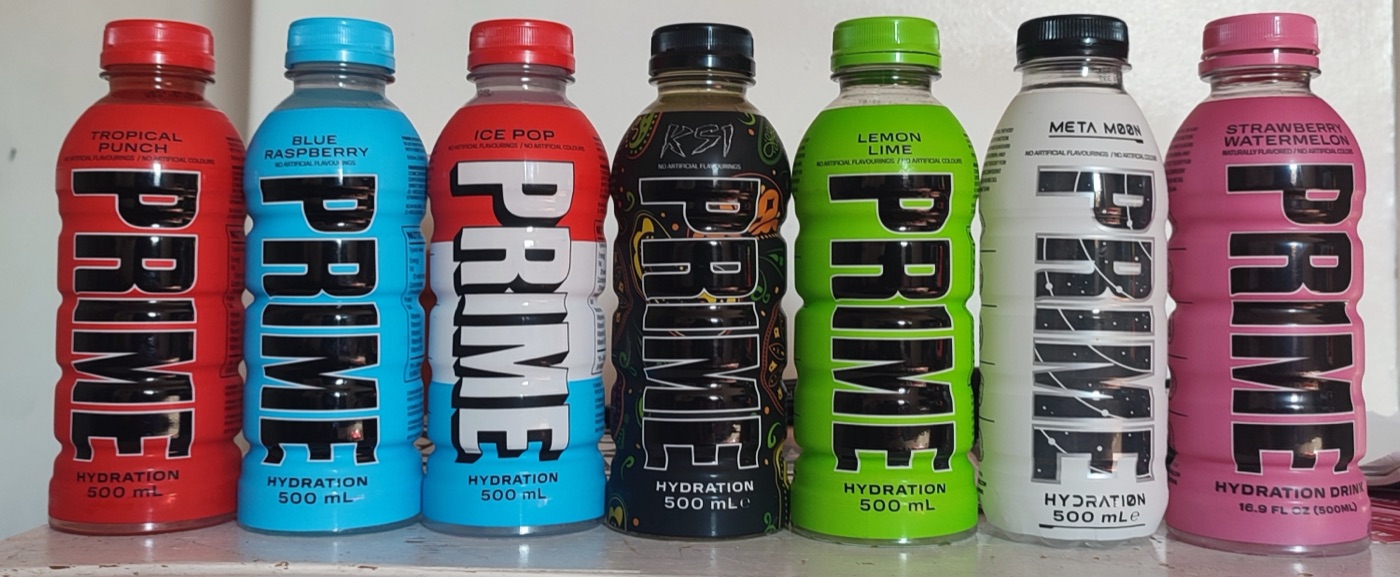
The flavour range that drove the queues. Collecting bottles is a first purchase behaviour, not a repeat one. Photo by Harry Cavanagh, used under a Creative Commons Attribution 2.0 licence.
Then it stopped.
By 2025 sales had dropped 42% in a single year, down to about $300 million, roughly R4.85 billion. Tubefilter reported Circana's data puts that at a 75% fall from the peak.
In the UK, where the accounts are public, the numbers show it plainly. Turnover fell from £112.2 million to £32.8 million. Net profit fell 91.6%. Marketing Week pulled those figures straight from the Companies House filings.
The shape of that fall is easier to see than to describe.
Prime Hydration, annual retail sales
The fastest brand launch ever, and the fall that followed
United States dollars. Rand values at R16.16 to the dollar.
Sources: 2022 and 2023 figures, Bloomberg. 2025 decline, Circana data reported by Tubefilter, 22 July 2025.
Arsenal did not renew. Coca-Cola took the shirt in August 2025. In July this year the Australian distributor, Congo Brands Australia, went into voluntary administration owing A$7.92 million with A$84,855 in the bank, although SmartCompany was careful to point out that is the distributor alone and not the global business.
The marketing never failed. It was the best any drink brand has ever had.
What failed was the second purchase.
Now look at the other side. Rhode, Hailey Bieber's skincare brand, went from nothing to $212 million in direct to consumer net sales in under three years on ten products, and CNBC reported that e.l.f. Beauty agreed in May 2025 to buy it for up to $1 billion.
The fame was the same. The launch advantage was the same. The outcome was the opposite.
One of them made something people wanted again.
Awareness versus demand: why brand recognition does not create repeat customers
Awareness and demand feel like the same thing from inside a business, and confusing them is the most expensive mistake in this article.
Awareness means people can name you. Demand means people pay you again once the novelty is gone.
In the first quarter of 2023, at the peak of the hype, Prime held 5.8% of United States sports drink sales by value, according to Circana data reported by just-drinks.
Gatorade held 43.8%, BodyArmor held 14.4% and Powerade held 7.6%.
Everybody assumed the most talked about drink on earth was also the biggest one, so put the four of them side by side by money and watch that impression fall apart.
United States sports drinks, first quarter 2023
"Number two in the world" was never true
Share of category sales by value, at the height of the hype.
The point
The most talked about drink on earth sat fourth by money, on less than a seventh of Gatorade's share. Being famous is not the same as being bought.
Source: Circana data, reported by just-drinks.
Prime sat fourth by money.
Close to 100% of Gen Z buyers could name the brand, according to Bradley Honan of Honan Strategy Group, writing in The Robin Report in July 2025. Only about 12% of them had bought it more than once, by his estimate.
That is one strategist's assessment, not a published study, so treat it as expert opinion rather than measured data, though his two figures next to each other still say more about the problem than a paragraph can.
Knowing a brand versus buying it twice
Everybody could name it. Almost nobody bought it again.
Prime, among Gen Z buyers in the United States.
These two figures are one strategist's assessment quoted in a trade publication. They are not measured data, there is no published study behind them and no sample size was stated. Read them as an informed opinion about the size of the gap, not as a statistic.
that killed it
The point
Awareness means people can name you. Demand means people pay you again once the novelty is gone. Only one of those pays the bills.
Source: Bradley Honan of Honan Strategy Group, quoted in The Robin Report, July 2025. This is his assessment, not a published study.
South African owners hit a smaller version of this every week. A reel does 400,000 views, the phone rings for two days, and the month still closes flat.
Views are not a business. Orders are. Repeat orders are what make those orders worth having.
What to do about it: stop reporting reach, start reporting how many customers bought from you a second time last month, and put that number at the top of your monthly sheet. The rest of the scorecard is in our guide to the best ecommerce KPIs to track every month.


Repeat customers are a profit lever, not a replacement for advertising
There is a wrong version of this argument and it gets repeated everywhere, so let us kill it before we go any further.
The wrong version says retention beats acquisition, so pull money out of ads and go work your existing list instead.
New customers grow a business. Repeat customers turn that growth into profit. Those are two different jobs and neither one replaces the other, which is why paid advertising on Meta and Google is still the only reliable way to get in front of people who have never heard of you.
A stuck business is almost always stuck on one of four things. Not enough people see you. Enough see you but too few of them buy. Enough buy but you charge too little to make money on the sale. Or people buy once and never come back.
Alex Hormozi makes the point that only one of those four is your real problem at a time, and that fixing the wrong one wastes money and often makes the actual problem worse.
So the honest advice is not "fix retention first". Find out which of the four is holding you.
If almost nobody knows your store exists, retention is not your problem yet. You cannot get a second order out of a customer you never got a first order from.
If people already find you, buy once and then vanish, more ad spend will not save you, because you will just pay to run more strangers through the same leak.
That is exactly where the drink brand sat. It had as much attention as any product in history, and no reason to buy the second bottle.
There is one more reason the second sale matters. The profit from customers who come back is what pays for the next new customer, so a store making R400 of gross profit per customer can bid more for a click than a store making R300. The Rand version of that is further down this page.
How to get repeat customers in South Africa: fix the product and the offer before the ad
Marketing has one honest job on the first sale. It gets the right person to try you once.
After that the product, the packaging, the delivery, the support and the price all take over, and together they decide whether a second order ever happens.
No ad rescues a bad experience the customer already had.
The drink brand had trouble on exactly that side. Health Canada recalled Prime Energy in July 2023 because the caffeine went over Canada's 180mg limit and the labelling did not comply.
New Zealand ruled the original formula illegal in June 2023, at 579mg per litre against a 320mg per litre limit, and the Netherlands blocked sales over caffeine that August.
In May 2024 a United States class action, Preudhomme v. Prime Hydration LLC, alleged the energy cans held 215mg to 225mg of caffeine against the 200mg on the label.
Those are product and trust problems. None of them is a marketing problem.
The skincare brand sold ten products. A small range people finish and reorder beats a big range people try once.
What to do about it: before you spend another rand on ads, phone ten customers who bought once and never came back. Ask what happened. You will hear the same three answers, and those answers are your growth plan, which is the ground we cover in what makes customers buy from you again.
How to identify the South African customer who buys from you twice
Most South African businesses can describe their audience. Far fewer can describe the person who buys from them a second time.
The audience is everyone the ad reaches. The repeat customer is the person whose life is better because your product exists, and who will find the money again next month.
The average South African real net salary fell to R20,198 in June 2026, down 3.6% on the year and the lowest in about two years, according to the PayInc Net Salary Index reported by IOL. For people earning R10,000 to R20,000 a month, almost a third of disposable income now goes to food alone.
Statistics South Africa put annual inflation at 5.0% in June 2026, up from 4.5% in May, official unemployment climbed to 33.6% in the second quarter, taking the number out of work past 8.5 million, and the Reserve Bank held the repo rate at 7% in July, so every bond and every vehicle instalment sat exactly where it already was.
That is the wallet you are selling into.
None of that means nobody is buying. South African online retail turnover hit R96 billion in 2024, grew 35% and made up 8% of all retail, according to World Wide Worx with Mastercard, Peach Payments and Ask Afrika.
Money is moving. It is just being spent more carefully, and careful buyers return to what already worked.
What to do about it: open your order history, pull every customer who has bought three or more times, and look at what they bought first, what they bought next, and what they paid. That short list is your real customer.
Your repeat purchase rate decides how hard you have to work for the same growth
Before the formula, here is what this number actually controls.
Picture two businesses. Both finish year three with exactly 300 customers.
The first one keeps nobody. It sells 100 customers in year one and they all leave, so it has to sell 200 fresh ones in year two to have 200, then another 300 in year three to have 300.
The second one keeps everyone. It sells 100 in year one, 100 in year two, and 100 in year three.
Same 300 customers at the end. The first business had to sell 600 to get there. The second sold 300.
The first one is a churn factory. The only way it can grow is by selling more than it sold last year, every year, and that road runs in one direction.
The second one builds on top of what it already has. That is the whole argument, and it does not need a single statistic behind it.
Repeat purchase rate is the share of your customers who buy more than once inside a set window of time, and it is the most honest number you have for telling those two businesses apart.
The formula is simple. Take the customers who placed two or more orders in the window, divide by the total customers who ordered in that window, then multiply by 100.
Pick a window and never change it. Ninety days works for most stores. Twelve months suits things people buy once a year, like furniture.
Here is that calculation as a picture, so you can see which number goes where.
Repeat purchase rate
How to work out your own repeat purchase rate
The share of your customers who came back and bought again.
Both numbers must come from the same fixed window, and you keep that window forever. 90 days suits most stores. 12 months suits things people buy once a year, like furniture.
Worked example
Source: standard repeat purchase rate definition, with the worked example used in this article. Pull both counts from your Shopify customer report or your invoicing system.
| What you need | Where to find it | Example |
|---|---|---|
| Total customers who ordered in the window | Shopify customer report, or your invoicing system | 1,240 |
| Customers with two or more orders in that window | Same report, filtered on order count | 285 |
| Repeat purchase rate | 285 divided by 1,240, times 100 | 23% |
Now the benchmarks, with their caveats attached.
- Metrilo measured an average ecommerce repeat purchase rate of 28.2%, from 20.9% in tea to 36.2% in CBD, with roughly 60% of revenue coming from repeat customers. Read it as a guide only, because it covers 65 businesses already using Metrilo's own tools, which makes it a self selected sample.
- Gorgias, looking across more than 12,000 merchants, found repeat customers made up 21% of customers but produced 44% of revenue and 46% of orders.
Hold onto that second split. A fifth of your customers are carrying close to half of your revenue, which is why the list of people who already bought from you deserves a real plan of its own and not just whatever attention is left over at the end of the month.
One warning before you go looking for this in your dashboard. Shopify and most reporting tools show a percentage of returning customers, and it is not the same number.
That one climbs on its own as a business gets older, because the pool of people who have ever bought from you keeps growing. It also climbs when your advertising weakens, because fewer new customers came in that month to dilute it. A store can watch it rise while the business shrinks underneath it. Work out the repeat purchase rate yourself instead, on a fixed window.
Repeat purchase rate misses one thing too. It counts customers who came back, not customers who came back and spent more than last time, and those bigger second orders are often where the real money sits.
What to do about it: calculate your 90 day repeat purchase rate this week, then calculate it again on the same date next month. You are not chasing a benchmark. You are chasing your own number going up.
What one extra repeat order is worth to you, in Rands
Percentages are easy to ignore, so here is the same idea in money.
Take a South African store doing 1,000 new customers a month at an average order value of R850, with a 35% gross margin after product cost and shipping.
Gross profit on one order is R297.50, which is R850 times 35%.
Say 20% of them come back and buy once more, which gives you 200 repeat orders, R170,000 in extra revenue and R59,500 in extra gross profit.
Now lift the repeat rate from 20% to 25%. Not double it. Five percentage points.
That gives you 250 repeat orders instead of 200, so an extra 50 orders, R42,500 more revenue and R14,875 more gross profit, every single month.
Over a year that is R510,000 in revenue and R178,500 in gross profit, from customers you have already paid to acquire.
Move that repeat rate five points and the money looks like this.
The money behind five percentage points
What one small lift in repeat buying is worth, in Rands
Worked on a South African store. Run it on your own numbers, not these.
Start with three numbers
R850 × 35% = R297.50 gross profit on every order
Now move the repeat rate five points
(50 × R297.50)
Over twelve months
in extra gross profit a year, from customers you have already paid to acquire
R14,875 × 12 months. That sits on R510,000 of extra revenue.
Source: worked example from this article. The inputs are illustrative, so replace them with your own order value, margin and repeat rate.
This is the number that should decide your ad budget. You spent nothing on ads to get those 50 extra orders, so nearly all of that R178,500 drops to the bottom line, while the same profit bought through ads needs real spend behind it every month.
Run this on your own numbers, not mine.
Lifetime value means gross profit, and it always needs a time window
Two things go wrong whenever people talk about customer lifetime value.
The first is that they use revenue. If a customer spends R1,000 with you and the product plus delivery cost you R650, that customer is worth R350. Revenue does not pay salaries. Gross profit does.
The second is that they leave the clock off it. Saying "our lifetime value is R900" means nothing on its own, because a customer who gets there in 90 days and a customer who takes three years to get there are two completely different businesses to run.
So say the window out loud. Gross profit per customer in 30 days, 90 days, 180 days and 365 days. Pick your windows and report the same ones every month.
One note on the formula, because the version you see quoted elsewhere is built for a different kind of business. Alex Hormozi's usual maths is price divided by churn rate, times margin, which works when customers pay you every month until they cancel. A store does not work that way. The right version for a store is average order value, times gross margin, times the orders one customer places inside your window, which is what we used above.
Why the second sale lets you outspend the store next door
Two stores can sell the same product at the same price and one of them can still afford to pay more for every customer.
Take two South African stores selling the same kind of product. Both sit at R850 average order value on a 35% gross margin, so both make R297.50 of gross profit on an order.
Store A gets 20 of every 100 customers to buy again inside 90 days, which is 120 orders per 100 customers and R357 of gross profit per customer.
Store B gets 40 of every 100 to buy again in the same 90 days. That is 140 orders, or R416.50 per customer.
Now the important bit. R357 is the most Store A can pay for a new customer without going backwards inside that window, and Store B can pay R416.50 for the identical customer.
So Store B bids R59.50 more in the same auction, for the same person, and stays profitable.
That is the honest case for retention, and it is not that advertising stopped mattering, it is that the second sale buys you the right to spend more on advertising than the store next door can.
Breaking even is not the target though. Alex Hormozi's rule of thumb is that the gross profit a customer brings you should be at least three times what you paid to get them. On that floor, Store A can afford R119 per new customer. Store B can afford R139.
Work your own version out. Divide last month's ad spend by the new customers it brought in. There is no published South African average for what a customer should cost, so anyone quoting you a local figure is guessing.
What to do about it: put these figures on one page and keep it where you look often. Once you know a five point lift is worth R178,500 a year, building the WhatsApp flow stops being a debate. To price a customer across their whole life, start with our guide to ecommerce customer lifetime value.
What actually drives customer retention, and which retention stats are overstated
Two lines get repeated in almost every article on this topic, and both are far weaker than the way they get quoted.
Claim one: a 5% increase in retention increases profits by 25% to 95%.
The research underneath it is real, but it says something far more specific than the version you keep reading. In "Zero Defections", published in Harvard Business Review in September 1990, Frederick Reichheld and W. Earl Sasser Jr were reporting on three particular industries, not announcing a law that applies to your store.
They found that cutting customer defections by 5% raised profits by 85% in one bank's branch network, by 50% in an insurance brokerage, and by 30% in an auto service chain.
So the measured range is 30% to 85%, across three named industries.
The 95% ceiling cannot be traced to a Bain publication that supports it, and Bain's own published brief backs "more than 25%", only for financial services, which is a long way from the universal promise the number carries when a marketing blog repeats it at you.
Claim two: acquiring a new customer costs five to 25 times more than keeping one.
Harvard Business Review itself presents that as a rule of thumb with thin sourcing, in a 2014 piece by Amy Gallo. It is not a measured finding at all, and there is no credible South African version either, so anyone quoting you a local acquisition multiple is guessing.
None of this makes retention overrated. The honest version is just more useful than the marketing version.
What to do about it: plan off your own two numbers, your repeat purchase rate and your gross profit per order, instead of a borrowed percentage.
What to fix first when repeat is broken, in the order that actually works
Almost every article on this subject opens with email and WhatsApp. That is the wrong end of the problem, and it is why so many stores buy retention software and then watch nothing change.
The list below runs from the thing that matters most down to the thing that matters least, so messages come last on purpose, and that is the part most owners get backwards.
Most owners work this list in reverse, so start at the top and be honest about where you actually are.
The ecommerce retention hierarchy
What actually makes a customer buy from you twice
Ranked by how much each one moves repeat purchase. Fix them in this order.
The counterintuitive bit
Email and WhatsApp sit at the bottom, and that is where nearly every retention project starts. A flow sent to people who did not like the product just makes them unsubscribe faster.
Source: Blue Sense Digital's ecommerce retention hierarchy.
- Make sure the product is worth buying twice. Nothing below this matters if the product itself disappointed. This is the ten phone calls from earlier. Slow delivery, a product that underdelivered, or a price that felt wrong the morning after. You cannot outmarket a product people did not enjoy.
- Give them something obvious to buy next. Plenty of stores have a retention problem that is really a range problem. If a customer finishes what you sold them and there is nothing natural to order after it, they are not disloyal, they are done. Look at your best seller and ask what the sensible second purchase is, then make sure you stock it.
- Look at who you acquired, and what offer brought them in. A customer who came in on a heavy discount tends to be worth less over time than one who paid full price. Groupon South Africa closed its local operations on 4 November 2016, as part of Groupon pulling back from 27 countries to 15, because the deal driven model ran out of road. Customers trained on discounts leave when the discount does. So "why did they not come back" is sometimes not a product answer at all, it is an answer about who your ads went and fetched.
- Fix what happens when something goes wrong. Every order carries a small chance of going sideways, and how you handle that hour decides the next twelve months with that customer. A support email nobody answered costs you far more than the refund would have, which is why we wrote about the importance of ecommerce customer support.
- Only now, set up the messages. You do not need expensive American software here, because the phone numbers and email addresses you already collected carry most of the work. South Africans open WhatsApp, so send one message when the order ships, one when it arrives, and one about a week after they would have finished the product, making it easy to reorder. That third message earns the money, and the flows sit in our guide to generating 15% more ecommerce revenue with WhatsApp automations. Then split the email list, because most stores send everybody the same thing. Buyers get a reorder reminder timed to how long the product lasts, everyone else gets a first purchase offer, and abandoned cart automations catch the orders that nearly happened.
- Give people a reason to stay that is not a discount. South Africans are already deep into loyalty. Truth Loyalty and BrandMapps surveyed 35,000 people for the South African Loyalty Landscape 2024/25 and found 82% of economically active South Africans use loyalty programmes, up from 76% the year before. Clicks ClubCard reached 80% usage, Checkers Xtra Savings 76% and Pick n Pay Smart Shopper 68%, while Woolworths has since replaced WRewards and MySchool with a single tiered programme, MyDifference. You cannot outspend Checkers on points. Beat them on first access to new stock, or a real person on WhatsApp who answers inside an hour.
What to do about it: start at step one, and do not skip to step five just because it is the easiest one to buy.
Key takeaways
- New customers grow the business. Repeat customers grow the profit, and that profit is what lets you pay more than a competitor to get the next new customer.
- Work out which of four things is stuck before you fix anything: too few people see you, too few of them buy, you charge too little, or nobody comes back. If nobody knows you exist yet, retention is not your problem yet.
- Awareness and demand are different things. Prime held only 5.8% of United States sports drink sales by value at its 2023 peak, against Gatorade's 43.8%.
- Two businesses can both finish year three with 300 customers. The one that keeps nobody had to sell 600 to get there, and the one that keeps everybody sold 300.
- Repeat purchase rate is customers with two or more orders divided by total customers in a fixed window, times 100. The percentage of returning customers on your dashboard is a different number, and it flatters you when your advertising weakens.
- On 1,000 customers a month at R850 average order value and 35% gross margin, lifting repeat purchase from 20% to 25% is worth R178,500 in extra gross profit a year.
- Lifetime value always means gross profit, never revenue, and it always needs a time window attached to it.
- The "25% to 95% profit lift" line is not what the research says. Reichheld and Sasser's 1990 Harvard Business Review study measured 30% to 85%, across three named industries.
- Email and WhatsApp come last. Product, range, who you acquired and how you handle problems all come first.
Want more of your customers buying a second time?
We bring the first buyer in with paid ads, then the email and WhatsApp flows behind the ad bring them back at almost no extra cost. That is how a store grows without the ad budget growing with it. V8 Media has driven R2+ billion in client sales since 2018. See how we grow ecommerce stores profitably, or get a free look at your Meta Ads and Google Ads.
Claim Your Free AuditFrequently asked questions
Should I focus on getting new customers or keeping the ones I already have?
Both, but not in the same month and not for the same reason. New customers are how a business grows, so if very few people know you exist, advertising is your fix and retention work will not help yet. Repeat customers are how that growth turns into profit, and that profit is what lets you pay more than a competitor for the next new customer.
What is a good customer retention rate?
There is no single good number, because retention swings hard by what you sell and how often people need it.
What is a good repeat purchase rate for ecommerce?
Metrilo measured an average of 28.2%, from 20.9% in tea to 36.2% in CBD. Treat it as a guide, not a target, because the study covered 65 businesses already using Metrilo's own tools, so it is a self selected sample.
How do you calculate repeat customer rate?
Divide the customers who placed two or more orders in a fixed window by the total customers who ordered in that window, then multiply by 100. For example, 285 out of 1,240 is 23%.
Is the percentage of returning customers on my Shopify dashboard the same as repeat purchase rate?
No, and it is a misleading number to plan on. The percentage of returning customers rises on its own as a business gets older, and it rises again when your advertising weakens and fewer new customers come in to dilute it. Work out repeat purchase rate yourself, on a fixed window.
How do you measure customer retention?
Track three numbers together each month: repeat purchase rate, average order value, and gross profit per order. The first two describe behaviour, and the third turns them into money.
Why are repeat customers more profitable than new customers?
Because you already paid to acquire them, so a repeat order costs a message instead of an ad, a click and a discount. Gorgias, across more than 12,000 merchants, found repeat customers were 21% of customers but produced 44% of revenue.
What is the difference between customer retention and customer loyalty?
Retention is behaviour you can count, meaning the customer bought again. Loyalty is preference, meaning the customer picks you even when a cheaper option is right there.
What is customer lifetime value and how do you calculate it?
Customer lifetime value is the total gross profit one customer produces across every order they place inside a set window of time. Always use gross profit rather than revenue, and always state the window, because 90 days and 365 days describe two very different businesses. The simple version for a store is average order value, times gross margin, times orders per customer. At R850, a 35% margin and two orders, that is R595.
How much does it cost to acquire a new customer versus keeping an existing one?
The widely quoted "five to 25 times more expensive" line is presented by Harvard Business Review itself as a rule of thumb with thin sourcing, and no credible South African version exists. Work it out yourself, by dividing your monthly ad spend by your new customers.
What are the key factors in customer retention?
Four things carry most of the weight: the product doing what the customer expected, delivery arriving when you said, support answering quickly, and a timely reason to come back.
What are examples of customer retention strategies?
The ones that work here without a big software budget are a post purchase WhatsApp sequence, a reorder email timed to when the product runs out, a split email list, and free delivery over a spend threshold.