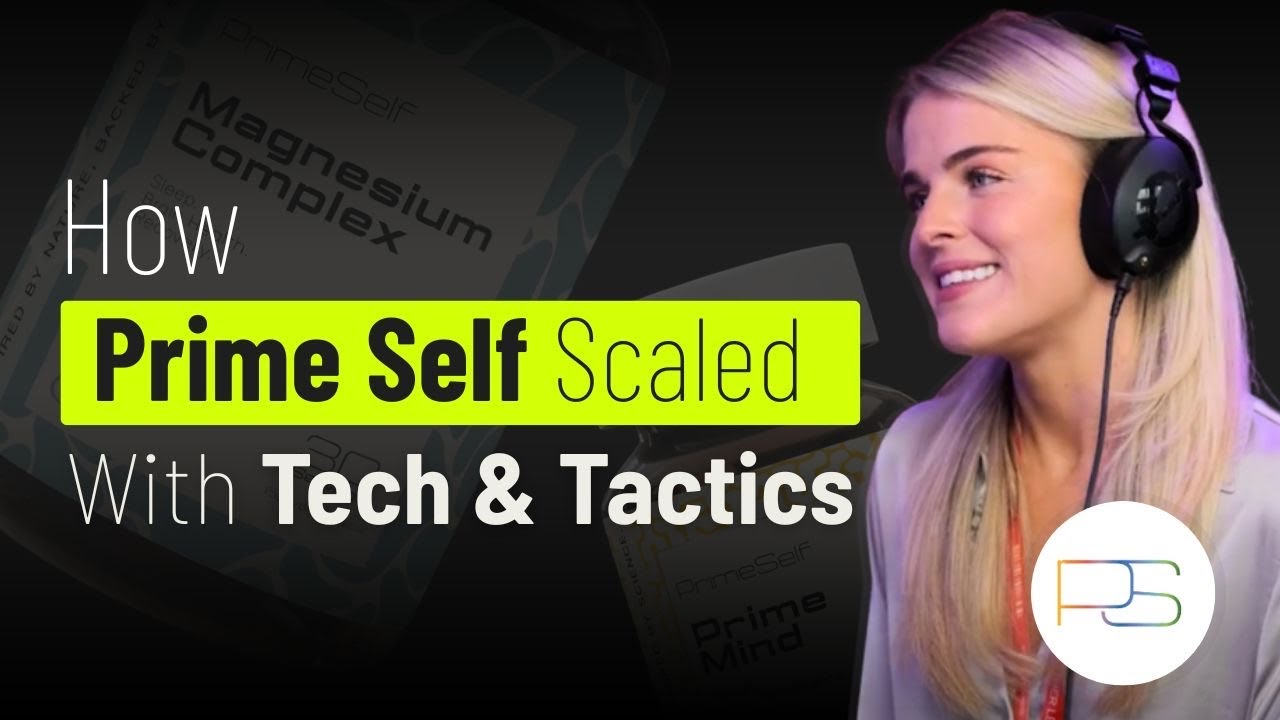
To scale a Shopify store in South Africa you do not need a hundred apps or a bigger market. You need a lean system. Run a clean Shopify store, keep only the apps that convert, save time or grow revenue, use an AI assistant to guide first-time buyers, let email automations sell on autopilot, and kill checkout friction with one-tap payments. That is the exact playbook Nicola, e-commerce manager at supplement brand Prime Self, used to hit a record month. Here is how to copy it.
Is e-commerce in South Africa actually dead?
No. And the people saying it is are usually the ones not selling anything.
Online retail is still a small slice of total South African retail. World Wide Worx's Online Retail in South Africa report puts it at around 8% in 2024, up from past 6% in 2023, on its way to roughly 10% by the end of 2025.
So yes, the market is smaller than the United States. That is not the point.
Prime Self just had a record month. One of their best to date. Steady growth, not luck.
You do not need US-level online penetration to win in South Africa. You need a product people actually want, distribution that works, and a customer journey that does not sabotage the sale.
You can complain about the economy, or you can build for it. Nicola is firmly in the second camp.
The brands winning here have a system. The ones blaming the market are usually missing one.
Why Shopify keeps winning for scaling
Prime Self runs on Shopify. So do most of the fast-growing South African brands we work with.
Nicola has run stores on multiple platforms. She tried WooCommerce and did not love it. Shopify is easier to use, easier to track, and easier to build on.
The real win is speed. With Shopify you spend less time fighting tech and more time fixing offers, creative and the customer journey.
Platforms do not grow your revenue. But a bad platform slows down the people who do.
Conversion tracking is simple. The analytics are strong. The builder makes sense without a developer on standby.
| What you need to scale | Shopify | WooCommerce |
|---|---|---|
| Time to launch | Days, no developer needed | Slower, usually needs setup help |
| Conversion tracking | Built in and clean | Plugins and manual config |
| Maintenance | Hosted, handled for you | You own updates and hosting |
| Apps and checkout | Tight app store, fast checkout | Flexible but easy to bloat |
WooCommerce is not bad. It is just more rope to hang yourself with when you are trying to move fast.
The lean stack rule: avoid app bloat or your store becomes a slideshow
Nicola is a minimalist. Not in a Pinterest way. In an "I refuse to let 100 apps turn my site into a slow, glitchy mess" way.
Her rule is simple. An app earns its place only if it does one of three things.
| The only 3 reasons to keep an app | What that looks like |
|---|---|
| It converts | Turns more browsers into buyers (reviews, a smart assistant, faster checkout) |
| It saves time | Automates work the team would otherwise do by hand |
| It increases revenue | Adds genuine sales, not just another dashboard |
Everything else is clutter with a monthly subscription.
Every extra widget is another chance to annoy someone into leaving. Ten pop-ups. Constant upsells. A spin-the-wheel game that makes your brand look like a casino.
Customers want a simple experience. Make it smooth. Make it fast. Sell the product cleanly.
This is the same discipline behind the 5 apps behind an 8-figure Shopify store. Fewer tools, used properly, beat a graveyard of half-installed plugins.


Use AI as a shopping assistant, not a gimmick
Prime Self's favourite app right now is Smartbot. It is an AI chatbot built into the Shopify store.
Nicola calls it a personal shopping assistant. That framing is the whole point.
Supplements are confusing. A product page can read like a science exam. Too many ingredients, too many goals, too many claims.
So the shopper panics and leaves. That uncertainty is the single biggest conversion killer in the category.
In a physical shop, someone meets you at the door and asks how they can help. Online, most stores dump you on a category page and hope you do not freeze.
The bot fixes that. You enter your name, your age, and what you want to solve. It recommends a product and explains why.
Nicola tested it herself. She asked it to compare NMN versus NAD Complex. It asked questions, gave a clear breakdown, and converted her to NAD Complex.
That is not support. That is sales. When choice is confusing, guidance is conversion.
The operational bonus matters too. The backend is easy, training the bot is simple, and it lives inside Shopify, so the team is not jumping between platforms to update it.
A good assistant is also the front line of service. We dug into why that matters in the importance of e-commerce customer support.
Email automations are the closest thing to passive income
Prime Self runs Omnisend. Nicola says it is powerful and badly underrated.
The team runs a strong set of automation flows and A/B tests them inside the tool. The standout is automation revenue, month after month.
The numbers back her up. Omnisend's email marketing benchmarks found automated emails make up only about 2% of sends but drive around 30% of all email revenue.
So a handful of flows you set up once can out-earn every campaign you blast out. This is where most stores miss the bag. They chase new traffic and ignore the people already in the building.
A welcome flow, an abandoned cart sequence, a post-purchase series. These run while you sleep.
Campaign emails still pull their weight too. The drag-and-drop builder means the team ships sends without turning every email into a design project.
List building is deliberately simple. A pop-up offers 10% off when you sign up. It appears once.
Sign up and it is done. Dismiss it and it does not keep haunting you like a needy ex.
The welcome automation delivers the discount, and it performs. Small lists grow fast when the offer is clear and the experience is not annoying.
- Offer a clear incentive for first-time visitors.
- Keep the pop-up controlled and non-invasive.
- Let the welcome flow do the heavy lifting.
If your list is thin, start here. We break down the full system in how to build and monetise an e-commerce email list.
Your acquisition mix: Meta, Google, TikTok and organic
Prime Self runs a lot of Meta ads. So much that people tell Nicola they "see the brand everywhere."
That is not luck. That is consistent spend, consistent creative, and a team watching the numbers.
They run Google Ads too. Different job entirely.
Meta creates demand. Google captures it. Meta introduces you to people who were not looking. Google confirms you when they start searching.
If you want that one-two punch done properly, that is the bread and butter of our Meta Ads and Google Ads management.
TikTok ads are next. They are testing it now. Smart move. That is where the eyeballs are going.
They also invest in organic. A marketing manager leads organic strategy, brand ambassadors push reach, and real customers send in UGC. SEO is ramping up too.
| Channel | Its job | When it pays off |
|---|---|---|
| Meta ads | Create awareness and demand | Cold audiences who were not searching yet |
| Google ads | Capture existing intent | People already searching for the product |
| Email automations | Convert and retain | Visitors and buyers you already paid to get |
| Organic and UGC | Build trust at low cost | Over time, compounding into brand demand |
Most brands get this backwards. They pour everything into ads, then wonder why profit is thin.
Paid gets you there faster. Email and organic make it worth the trip.
Checkout is the easiest win most stores ignore
If Nicola credits one thing for the conversion jump, it is the checkout.
Prime Self moved to Stitch for both Prime Self and NeuroActive at the end of June. Checkout conversion rate climbed week over week straight after.
They saw improvements all the way through, from abandoned cart to completed order.
The Stitch backend showed heavy use of Apple Pay and Google Pay. That usage is the whole story.
Customers want to pay fast. Nobody wants to type a 16-digit card number on a phone while the dog is barking and the kettle is going.
The same shopper who breezes through a Takealot checkout in seconds will bail on your store the moment it makes them work.
This matters more than founders think. Baymard Institute, which has tracked checkout behaviour for years, puts the average documented cart abandonment rate at around 70%.
That means roughly seven in ten people who add to cart walk away. A clunky checkout makes it worse.
Put a number on it. Spend R50,000 a month driving traffic, then lose most of your add-to-carts at a slow checkout, and you are setting real money on fire every single day.
Nicola admits payment providers were not top of her list before. After switching, she realised how critical checkout friction really is.
That is a lesson most founders learn far too late, which is a pity, because it is one of the cheapest wins on the table. We covered the local angle in how Stitch is changing the payments game.
Convenience is the last thing standing between your customer and paying. Do not waste it.
Site optimisation: fast, clean and built for humans
Nicola's first site rule is the one people hate. Remove stuff.
Cut the unnecessary apps. Speed matters. A smooth experience beats a feature-rich mess every time.
No endless pop-ups. No aggressive upsells. No gimmicks that make the store feel like a trap.
Smooth stores convert because they feel safe. Safe is what gets a stranger to hand over a card.
Her second rule is to use AI for the customer experience, especially where uncertainty kills the sale. A chatbot that guides a confused first-time buyer is worth more than another banner.
They also use AI behind the scenes. Email ideas, copywriting prompts, product captions. The team uses it to generate drafts, then adds the human voice.
AI guides the work. Humans own the voice. That balance keeps the brand sounding like a brand, not a robot.
If you only fix one thing this month, fix the leak that costs the most. We ranked them in the biggest e-commerce conversion rate mistake.
Advice for new founders: demand first, then build the store
Nicola's advice starts with product-market fit. You need a product people genuinely want.
Without that, no platform, ad account or influencer will save you. Marketing only amplifies what is already true.
Her line on this should be taped to every founder's monitor. If you have a mediocre product, marketing will only tell more people you have a mediocre product.
Then she gets practical. Get a Shopify store. Build the site. Use Shopify's tools and AI features to launch faster than ever.
Promote organically on social to get your first traction. When sales start, reinvest. Put some revenue into a marketing budget and test what works.
Expect early failures. Learn and iterate. That is the cost of entry, not a sign you are doing it wrong.
The line that lands hardest is about momentum. You will not see five steps ahead. You never do.
Take the first step and the next one shows up. Nicola calls it walking in faith.
Standing out in a crowded market: transparency and quality
The interviewer asked the question every founder fears. What if a billion brands sell the same thing?
Nicola's answer is two words. Transparency and quality.
Prime Self is open about what is in the products, where the ingredients come from, and how they are sourced. They publish it across social, product pages and the website.
That transparency backs up the quality claim. Ingredients are tested, then tested again, before anything goes to market.
For supplements, this is everything. If your product goes inside someone, trust is the conversion rate.
South Africans value quality and trust. They want to know exactly what they are buying, especially in anything that touches their health.
That is also what drives the part most stores forget, the repeat purchase. We unpacked it in what drives repeat purchases.
The bigger lesson
Prime Self's growth is not built on hype. It is built on doing the fundamentals well.
Shopify for speed. A lean app stack for performance. Omnisend automations for steady revenue. Meta and Google for scale. UGC and organic for trust.
Then they doubled down on the part most stores ignore. Checkout convenience, through Stitch, Apple Pay and Google Pay.
When you stop fighting the customer at every step, the sale stops feeling like a wrestling match.
None of this is exotic. It is just executed properly, in the right order, by a team that picked systems over chaos.
Key takeaways
- E-commerce in South Africa is growing, not dead. Online retail hit roughly 8% of total retail in 2024 (World Wide Worx).
- Run on Shopify for speed and clean tracking, then keep your app stack ruthlessly lean.
- Only keep an app if it converts, saves time, or increases revenue. Everything else is clutter.
- Use an AI shopping assistant to guide confused buyers. Guidance is conversion.
- Email automations are your passive income. Build the list with one clear, non-annoying offer.
- Checkout is the cheapest win. One-tap payments like Apple Pay and Google Pay beat cart friction, with around 70% of carts abandoned on average (Baymard).
- Demand first, store second. Marketing only amplifies a product people already want.
Want a lean Shopify store that actually scales?
Got a product that sells but a store that leaks? At V8 Media SA, our e-commerce team audits your Shopify setup, kills the checkout friction, and builds the email, AI and ad systems that compound. Book a free call and we will show you the biggest wins first.
Claim Your Free AuditFrequently asked questions
How do you scale a Shopify store in South Africa?
Run a lean, fast Shopify store and keep only the apps that convert, save time or grow revenue. Use an AI shopping assistant to guide first-time buyers, run email automations to sell on autopilot, and remove checkout friction with one-tap payments like Apple Pay and Google Pay. Then drive traffic with Meta for demand and Google for intent. That is the playbook Prime Self used to hit a record month.
Is e-commerce still worth it in South Africa?
Yes. Online retail reached roughly 8% of total South African retail in 2024 and is projected to keep climbing toward 10% in 2025, according to World Wide Worx. The market is smaller than the United States, but you do not need US-level penetration to win. You need a product people want, distribution that works, and a checkout that does not lose the sale.
Shopify or WooCommerce for a South African store?
For most brands that want to move fast, Shopify wins. It launches in days without a developer, has clean built-in conversion tracking, and handles hosting and updates for you. WooCommerce is more flexible but easier to bloat and slower to maintain. Prime Self tried WooCommerce and switched to Shopify for exactly these reasons.
How many apps should my Shopify store have?
As few as possible. Keep an app only if it does one of three things: convert browsers into buyers, save your team time, or genuinely increase revenue. Every extra widget slows the site and adds another chance to annoy a customer into leaving. App bloat is a silent conversion killer.
Does an AI chatbot actually increase sales?
It can, when it works like a shopping assistant rather than a help desk. For confusing categories like supplements, a bot that asks about your goals and recommends the right product reduces the uncertainty that makes people leave without buying. Prime Self uses Smartbot inside Shopify to do exactly this, and it converts.
Which payment methods should a South African store offer at checkout?
Offer fast, low-friction options like Apple Pay and Google Pay alongside card payments. South African shoppers buy heavily on mobile, and typing a full card number on a phone loses sales. With around 70% of carts abandoned on average (Baymard Institute), a smooth one-tap checkout is one of the cheapest conversion wins available.
How much should I spend on ads to grow an online store?
Start small and reinvest. Get initial traction organically, then put a portion of early revenue into paid ads and test what works. Use Meta to create demand from cold audiences and Google to capture people already searching. Expect early failures, judge results over weeks not days, and scale only what proves profitable.