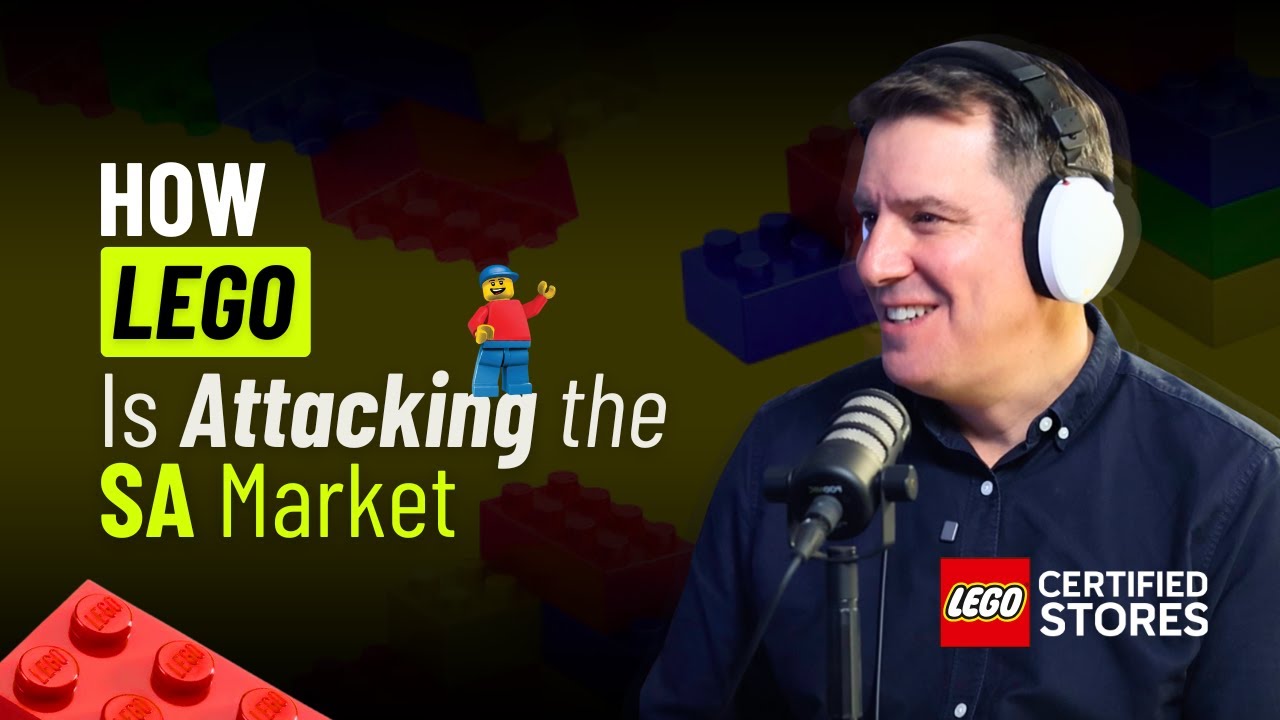
The LEGO Certified Store in South Africa is run by The Great Yellow Brick Company, founded in 2017 by Rob Greenstein, his wife Hayley, and partner Greg Bergh. They opened the first store in Sandton City in July 2018, the first LEGO Certified Store on the African continent, and grew to multiple locations nationwide. But the real story is not the toys. It is how they turned a global brand into a profitable retail engine with omnichannel selling, an honest Black Friday strategy, and frictionless payments. Here is the full playbook, pulled from our interview with Rob on the V8 Media podcast, plus what you can steal for your own brand. From V8 Media, the team behind R2+ billion in client sales since 2018.
Who runs the LEGO Certified Store in South Africa?
The LEGO Certified Store in South Africa is operated by The Great Yellow Brick Company. Not LEGO itself.
LEGO licenses the branded retail channel to local partners. In South Africa, that partner is Rob Greenstein, his wife Hayley, and their partner Greg Bergh, who founded the business in 2017, per the company's own site at greatyellowbrick.co.za.
They opened the first store in Sandton City in July 2018. It was the first LEGO Certified Store on the African continent, a launch covered by South African outlets like The Citizen at the time.
That matters. Global brands do not hand the keys to just anyone.
Here are the fast facts before we get into the lessons.
| LEGO Certified Store SA | Detail |
|---|---|
| Operator | The Great Yellow Brick Company (licensed by the LEGO Group) |
| Founders | Rob Greenstein, Hayley Greenstein, Greg Bergh |
| Founded | 2017 |
| First store | Sandton City, opened July 2018, the first LEGO Certified Store in Africa |
| Online store | Launched about a month after Sandton, at greatyellowbrick.co.za |
| Locations | Sandton City, Menlyn Park, Canal Walk, Gateway, Mall of Africa, and the V&A Waterfront, plus a newer store in the Somerset West area (per our interview) |
| Business model | Omnichannel retail: physical stores plus ecommerce that feed each other |
Sources: the company's own store at greatyellowbrick.co.za, South African press coverage of the 2018 Sandton City opening, and our founder interview with Rob Greenstein on the V8 Media podcast.
So why does a toy story matter to you? Because this playbook works for any product brand.
Most founders think a strong brand removes business problems. Wrong. It just gives you a bigger stage to solve them on.
How did LEGO Certified Stores come to South Africa?
LEGO was already in South Africa for years. It just sat on shelves inside multi-brand toy shops.
You could buy a set. You could not get the full brand experience.
Rob spotted that gap. He came from retail, so he understood something simple.
When a brand owns the experience, it owns the story, the shelf, and the "I came for one set and left with three" effect.
But South Africa is a small market on the global map. Big brands do not sprint into small markets on a hunch.
So the early years were not about opening stores. They were about building trust and proving the numbers could work.
It paid off. LEGO invited them to tender for the licensed channel in 2017, which is corporate-speak for "prove you will not embarrass us."
They won. Sandton opened in July 2018, and the online store followed about a month later.
That timing was deliberate. Launching online right after the store was not a nice-to-have.
It built a proper omnichannel business from day one, instead of the usual "we will add ecommerce later" panic when customers start shopping from the couch.
From the start, the goal was never a store. It was a system. We break that idea down in how omni-channel marketing works and is it worth it.
Why did the Sandton opening shock them?
They expected excitement at the Sandton launch. They got a stampede.
Rob compared it to an Apple launch. People queue because it is not a purchase, it is a moment.
LEGO has that same "I was here when it happened" energy, especially for collectors and adult fans.
Here is the trap, though. Big crowds can fool you.
Foot traffic and hype make an opening look like a win. Meanwhile the numbers can be leaking in the background.
Retail has a sneaky habit. It rewards you with applause while quietly posting you the invoice.
The opening proved something deeper too. LEGO had shifted from a toy product to a passion product.
People were not only buying for kids. They were buying for themselves.


Why is LEGO a passion product, not just a toy?
LEGO is one of the rare products a whole household enjoys without anyone rolling their eyes.
Kids build it as a toy. Adults build it as a hobby. Both sides feel like they won.
That is why a LEGO bonsai tree set makes sense, even though a bonsai is not the first thing you expect in a toy aisle.
It is also why sets tied to Star Wars, cars, art, and movies sell so hard. They tap communities that already exist.
Rob explained how LEGO keeps expanding into new passion categories.
There are art sets, like a Van Gogh "Starry Night" build that goes on a wall. Now LEGO is décor, not clutter.
There is speed culture, with a Formula 1 partnership and desk-sized builds fans display like trophies.
There are gaming tie-ins too, because if you want future customers, you go where their attention already lives.
And there is a deeper play worth copying. LEGO still needs kids, because kids are the fans of the future.
But LEGO keeps adults hooked with nostalgic releases, because adults have money and happily pay for emotional value.
That is how you sell to a kid today and still get their wallet when they turn 35.
Why "busy" did not mean "profitable"
The public saw queues, sales, and happy Instagram photos. The business saw rent, payroll, and stock sitting in a premium mall.
After year one, the team looked back and felt uncomfortable.
They were selling a lot. But the business was not as financially strong as it needed to be to scale.
This is where most founders trip. They confuse revenue with health.
Retail can post big top-line numbers while quietly choking on costs. Especially with premium mall rent in Sandton.
And if you scale a flawed model, you do not get a bigger business. You get a bigger problem, with more zeros on the mistake.
So they swapped excitement for precision. They went after cost of occupation, staffing, and the overheads customers never see.
Customers clap for experience. Banks clap for cash flow.
| What the public sees | What the business actually fights |
|---|---|
| Long queues at the opening | Premium mall rent due every single month |
| Big revenue numbers | Thin margins after staff, stock, and overheads |
| A store that looks the part | Cost of occupation that can sink the model |
| "It must be printing money" | Profit is a spreadsheet with sharp teeth |
The lesson is brutal and simple. Vanity revenue is not the goal. Profit is. We go deeper in what drives repeat purchases, because repeat buyers are where the real margin hides.
How did they balance global brand standards with SA costs?
Running a LEGO Certified Store is not like running a random shop where you improvise the layout and call it creative.
The experience has to match global standards. The brand promise is consistency.
Rob said a customer should walk into Sandton and feel the same brand magic they would feel in London, New York, or Paris.
That consistency protects LEGO. It also piles pressure on the operator.
Now stack South African reality on top. Local rentals, staffing, logistics, and consumer behaviour all hit the margin.
You are juggling global expectation with local economics, while pretending you are calm about it.
Founders call this growth. Some days it feels like survival wearing a blazer.
This is why Rob kept coming back to one word. Partnership.
Instead of pretending everything was fine, they negotiated lease structures that made the tenant-landlord relationship sustainable for the long run.
Because a store does not fail when you run out of passion. It fails when you run out of runway.
The LEGO Black Friday strategy, step by step
Black Friday is where most brands torch their credibility. They treat it like a discount festival instead of a trust test.
Rob's rule is blunt. Your offer must be authentic and meaningful.
No fake specials. No "was R999, now R998" maths that insults the customer.
Shoppers are not stupid. They are tired. And they can smell nonsense faster than Eskom burns diesel.
Here is the strategy, broken into steps you can copy.
- Pick an offer the customer genuinely wants. Not what you over-ordered. Not what your team is emotionally attached to. Something with proven demand and a high "I have been waiting for this" factor.
- Make it genuinely unique for the season. Rob looks for items that have never been discounted. Repeating the same sale trains customers to wait and weakens your pricing power.
- Use a loss leader to pull people into your world. A loss leader is a deal you barely profit on, used to win the customer. Last year they cut the LEGO Titanic set by 30%, per our interview. It sold out in under two days.
- Make the journey frictionless. Rob hates ads that dump you on a generic homepage. If the email says a Star Wars set launches on Black Friday, the click must land on the Star Wars page, not a homepage that forgets the promise.
- Use incentives that build loyalty, not chaos. LEGO uses exclusive gifts-with-purchase you cannot buy separately. That creates collector urgency without a race to the bottom on price.
Discounting is one lever. Exclusivity and scarcity are two more. And those two protect your margin.
That is the difference between a real offer and a loud one. We unpack it further in the price vs value equation.
Why omnichannel consistency builds trust
One of their smartest moves was simple. Same prices online and in store.
Retailers love to annoy customers with a special in one channel that vanishes in the other.
That frustration turns into distrust. Distrust turns into lost sales.
When people spend money, they get emotional. And emotional people remember how you made them feel.
Rob's approach is almost funny in how obvious it is. Do not annoy customers when they are trying to give you money.
They also linked customer purchase history across every store and the website.
Buy in Sandton today, buy in Cape Town next month, and your profile still lives in one ecosystem.
That is how you build lifetime value instead of chasing one-off sales.
They use email the same way. As a tool, not a fire hose.
Email works when the customer opted in because they actually want the news. It becomes spam when you blast people with no connection to the product.
| The trust killer | The LEGO SA way |
|---|---|
| Online price differs from in-store price | One consistent price across every channel |
| Customer history trapped in one store | One profile linked across stores and ecommerce |
| Generic email blasts to everyone | Relevant emails to people who opted in |
| Ad clicks land on a random homepage | Clicks land on the exact product promised |
Relevance is the line between helpful and blocked.
Payments: make it easier for people to give you money
Rob highlighted a truth most stores ignore. Less friction means more conversion.
They switched payment gateways partly to add options like Apple Pay and Google Pay.
Apple Pay usage jumped almost immediately after they switched it on, per our interview. That is not magic. It is convenience.
Convenience wins when attention spans are short and the customer's thumb is already hovering over the back button.
They also looked at buy-now-pay-later. These tools lift conversion because they shrink the immediate pain of paying.
You still pay the full amount. It just feels smaller in the moment, so the decision gets easier.
Retail is a psychology game disguised as a shopping cart.
Yes, buy-now-pay-later can push people to overspend, and consumer debt pressure in South Africa is real. Rob's view is that the shopper owns that call.
On pure conversion, frictionless payments are still one of the highest-ROI upgrades most ecommerce sites can make. We saw the same theme in how Stitch is changing the payments game.
Advice for founders expanding into retail
Rob's warning was sharp. Passion is not a business model.
People open stores because they love coffee, fashion, gym gear, or tech. Then they oversell the dream to themselves.
They buy fancy equipment, pick a "cool" spot, and assume the world will show up. Then the mall lease arrives and they learn what "binding" means.
The real edge is discipline and mall selection. They only have a handful of stores because they have been cautious and strategic about every location.
They pick malls that match their customer and can deliver the volume the model needs.
A bad mall is not a small slip. It is a multi-year financial commitment with your name on it.
Here is what to be conscious of before you expand.
- Understand your customer profile before you choose a mall.
- Model your costs with brutal honesty, not best-case dreaming.
- Negotiate with landlords as partners, not enemies.
- Do not scale until your first store model is financially tight.
- Unify online and offline from day one, not "later".
And please do not sign a lease because the shop looks cute on Pinterest. You cannot pay rent with aesthetic. We make the same point in how Tshepo Jeans became SA's top luxury denim brand.
The LEGO SA playbook you can steal
You do not need a global license to use this discipline. You need focus and the guts to run a tight model.
Here are the moves baked into the business.
- Build a system, not a store. Launch online and offline together so they feed each other.
- Do not trust the applause. Busy is not profitable. Check the margin behind the queues.
- Protect the brand experience. Consistency is what makes a customer trust you twice.
- Run an honest Black Friday. A real, unique offer beats a loud fake one every year.
- Keep prices consistent across channels. Do not punish loyal customers for shopping the "wrong" way.
- Remove payment friction. Every extra click at checkout is a customer you might lose.
- Pick locations like your life depends on it. One bad mall can sink years of profit.
That is the whole game. Not luck. No guessing. No vibe-and-pray. Just a tight model run with discipline.
How V8 Media builds retail and ecommerce brands like this
Most agencies just throw traffic at a store and hope. More traffic into a leaky funnel only burns cash faster.
We run both sides. We drive the right traffic with Meta Ads and Google Ads. Then we fix the offer, the landing page, and the checkout so the sale actually happens.
For a brand like LEGO SA, the paid search funnel matters. When someone Googles a set, the ad has to land them on the exact product, not a generic page. That is the kind of thing our Google Ads work fixes.
Most agencies stop at the first half, then wonder why the ROAS never reaches the bank.
We have done this since 2018. R2+ billion in client sales. Win the click, then win the sale.
Frequently asked questions
Who owns the LEGO Certified Store in South Africa?
The LEGO Certified Store in South Africa is not owned by LEGO directly. It is run by a licensed partner, The Great Yellow Brick Company, founded in 2017 by Rob Greenstein, his wife Hayley, and partner Greg Bergh. LEGO licenses the branded retail channel to local operators, and in South Africa that operator is The Great Yellow Brick Company, per the company's site at greatyellowbrick.co.za.
When did the first LEGO Certified Store open in South Africa?
The first LEGO Certified Store in South Africa opened in Sandton City in July 2018. It was the first LEGO Certified Store on the African continent. The online store at greatyellowbrick.co.za followed about a month later, which gave the business an omnichannel foundation from the start instead of bolting on ecommerce afterwards.
Where are the LEGO Certified Stores in South Africa?
The Great Yellow Brick Company operates LEGO Certified Stores in major South African shopping centres, including Sandton City in Johannesburg, Menlyn Park in Pretoria, Canal Walk in Cape Town, Gateway in Umhlanga, Mall of Africa in Midrand, and the V&A Waterfront in Cape Town, plus a newer store in the Somerset West area, per our interview with Rob. They also sell online nationwide at greatyellowbrick.co.za.
What is the LEGO Certified Store Black Friday strategy?
According to Rob, the rule is that the offer must be authentic and meaningful, never a fake discount. They pick an item customers genuinely want, make it unique for the season, and sometimes run a loss leader to win new customers. One year they cut the LEGO Titanic set by 30%, per our interview, and it sold out in under two days. They also use exclusive gifts-with-purchase to create urgency without a race to the bottom on price.
Why is LEGO so popular with adults, not just kids?
LEGO has shifted from a toy product to a passion product. Adults buy sets for nostalgia, stress relief, and décor, with ranges like the bonsai tree, Van Gogh art builds, and Formula 1 sets. LEGO keeps kids engaged as the fans of the future, while nostalgic and adult-focused releases keep grown-ups spending. That is how the brand ages with the customer instead of aging out.
What can my business learn from the LEGO Certified Store in South Africa?
The biggest lesson is that a strong brand does not remove business problems, it just gives you a bigger stage to solve them. Build a system across online and offline, do not confuse busy with profitable, run an honest Black Friday, keep prices consistent across channels, remove payment friction, and pick locations with discipline. Systems and numbers beat passion alone.
Key takeaways
- The LEGO Certified Store in South Africa is run by The Great Yellow Brick Company, founded in 2017 by Rob Greenstein, Hayley Greenstein, and Greg Bergh, with the first store opening in Sandton City in July 2018.
- It was the first LEGO Certified Store on the African continent, and the online store launched about a month later to build a true omnichannel business.
- Busy is not profitable: after year one they had strong sales but a model that needed fixing, so they attacked cost of occupation and overheads before scaling.
- Their Black Friday strategy is built on authentic, unique offers, including a 30% cut on the LEGO Titanic set that sold out in under two days, per our interview.
- Omnichannel consistency builds trust: one price, one customer profile, and relevant email across stores and ecommerce.
- Frictionless payments like Apple Pay lifted conversion, and disciplined mall selection protects the business from costly multi-year mistakes.
Want to build a retail or ecommerce brand that actually turns a profit?
R2+ billion in client sales since 2018. Not because we are clever. Because we fix the boring stuff first: offers, omnichannel consistency, checkout, and follow-up, then pour fuel on what works. See how we grow ecommerce brands profitably, or get a free look at your Meta Ads and Google Ads.
Claim Your Free Audit