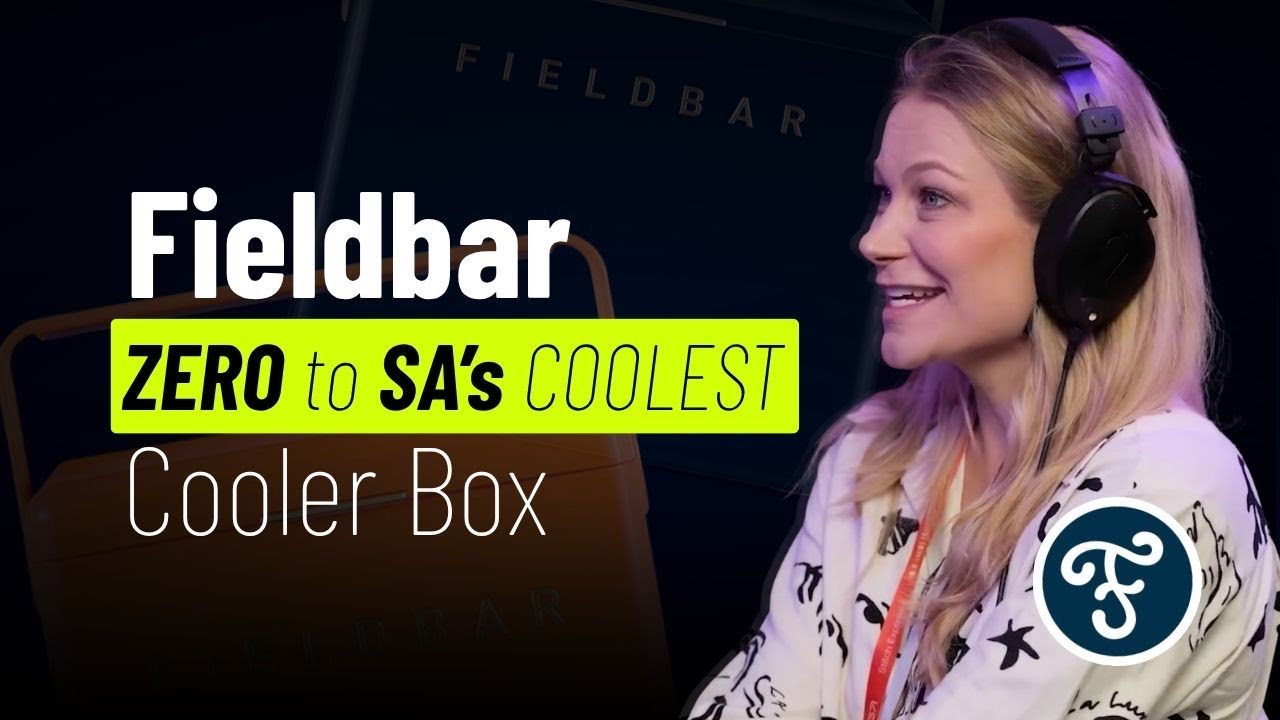
Fieldbar is a South African cooler box brand, founded in 2018 by Lee Hartman and Corban Warrington, and handcrafted in Cape Town. It makes premium "drinks box" coolers with leather handles and 50-hour ice performance, and sells them direct to consumer plus through luxury retailers like Harrods and Fortnum & Mason. Fieldbar turned a boring product into a luxury brand by doing four things well: designing for identity instead of utility, building a real story, owning the customer through its own Shopify store, and using paid media as a discovery engine. It topped News24 Business' fastest-growing companies list in April 2026, with around 1,600% growth and R134 million in revenue in 2024. Jess, who oversees ecommerce and paid media, broke down the playbook in our V8 Media interview. Here is the full Fieldbar story, plus exactly what your store can steal. From V8 Media, the team behind R2+ billion in client sales since 2018.
Who is behind Fieldbar?
Fieldbar was founded in 2018 by Lee Hartman and Corban Warrington, per How We Made It In Africa.
Lee Hartman is a serial founder. Chartered accountant, then banking, then he built and sold a media business and a software company before Fieldbar.
So this was not a first attempt at building something. He had done the hard yards before.
The brand is handcrafted in Cape Town. That detail matters, and we will come back to why.
Fieldbar also took investment from Invenfin, the venture capital arm of South African group Remgro, per Invenfin's own site.
Here are the fast facts before we get into how they grew.
| Fieldbar | Detail |
|---|---|
| Founders | Lee Hartman and Corban Warrington |
| Founded | 2018, Cape Town, South Africa |
| What it is | Premium direct-to-consumer cooler box brand |
| Products | Drinks Box coolers, cooler box sets, leather handles, outdoor goods |
| Store platform | Shopify |
| Revenue | R134 million in 2024 (per News24 Business) |
| Growth | ~1,600%, topped News24's fastest-growing companies list, April 2026 |
| Stockists | 200+ stores incl. Harrods, Fortnum & Mason, Williams-Sonoma, Anthropologie |
| Investor | Invenfin (VC arm of Remgro) |
Sources: How We Made It In Africa (founders, founding year, Cape Town manufacturing); News24 Business fastest-growing companies list, April 2026 (R134m revenue, ~1,600% growth); Bizcommunity (200+ stores, retail partners); Invenfin (investment); first-party operating details from the V8 Media interview with Jess.
So why does a cooler box brand matter to you if you sell skincare or biltong? Because the playbook is the same.
Sell identity, not features. Own the customer. Use ads to get discovered. Protect your pricing.
How did Fieldbar start? A cooler box used in shame
Fieldbar did not start with a business plan. It started with an observation.
People were using cooler boxes at urban events. Rooftops. Garden parties. Outdoor dinners.
But they were hiding them. Covering them. Trying to make the thing look less embarrassing.
Cooler boxes were built for rugged camping. Not for a design-forward dinner party.
That was the gap. A useful product that did not match how people wanted to feel.
So Fieldbar partnered with a product designer. The brief was simple. Perform like the best cooler on the market, but look like it belongs on the table.
The first Fieldbar launched in 2020, per the V8 Media interview.
And the most boring product in the room became the most talked about.
This is the bit most ecommerce brands miss. They sell what a product does. Fieldbar sold what owning it says about you.
Why did Fieldbar build a luxury brand instead of competing on price?
Jess is clear on this. Fieldbar runs a luxury marketing strategy, and that decision touches everything.
Creative. Copy. Distribution. The whole customer experience.
Luxury brands do not beg for attention. They invite you in.
That is the opposite of racing competitors to the bottom on price. A race to the bottom has only one prize. A smaller margin.
Their story is safari and outdoor heritage. Handcrafted in Cape Town. That story travels to London and New York.
It is why a cooler box can cost several thousand Rand and still sell out. When nobody knows you yet, your story is your differentiator.
A great product is expected. Good design is expected. What nobody does is make all three say the same thing at once. That is coherence. That is why Fieldbar costs what it costs.
Fieldbar nailed all three. That is why a cooler box can sit in Harrods next to handbags and nobody blinks.
The lesson for your store. People do not pay a premium for plastic. They pay a premium for meaning.


Why does owning your own store (DTC) matter so much?
Fieldbar did not start by blasting ads everywhere on day one. They tested. They validated. They refined.
From around 2020, online became the core growth engine. The setup is clean.
fieldbar.co.za serves South Africa. fieldbar.com serves international markets.
They sell direct to consumer, so they own the customer relationship. But they did not ignore retail.
And not just any retail. Harrods. Fortnum & Mason. Williams-Sonoma. Anthropologie. Over 200 stores, per Bizcommunity.
Those are not just distribution channels. They are credibility machines.
If Harrods sells it, customers assume it is premium. Trust is borrowed. Status is transferred.
This is the same DTC-first thinking that built Litehouse into an 8-figure brand, which we break down in how Litehouse became an 8-figure light empire.
And when you own the customer, you get the thing a marketplace will never give you. You find out why people almost did not buy. Then you fix it.
How does Fieldbar use paid media? Discovery before conversion
Jess oversees ecommerce and paid media, and her view is blunt. Paid media is critical.
It is the discovery engine. It is how a stranger first meets the brand.
Nobody wakes up Googling "Fieldbar". They discover it, usually on Instagram, then go looking.
So Instagram is the primary driver, especially internationally. Discovery-first brands win on Meta.
Paid media built their South African growth. Now they are replicating that playbook internationally. Slowly. On purpose.
This is the core idea most brands get backwards. Meta wakes people up. Search catches them after.
That is why we run Meta Ads for discovery and pair them with Google Ads to catch the demand once people start searching.
If your product creates desire on sight, Meta is your stage. A cooler box that looks this good was made for the feed.
Which metrics does Fieldbar actually track?
Jess keeps it simple. ROAS matters. You can burn money very quickly on paid media, because there is no ceiling.
But conversion matters more. Discovery means nothing if it does not lead to a purchase.
Clicks do not pay salaries. Conversions do.
This is the trap most stores fall into. They celebrate reach and traffic while the till stays quiet.
| Metric | What it tells you | Why Fieldbar watches it |
|---|---|---|
| ROAS | Revenue earned per Rand of ad spend | Keeps spend honest, but can lie if conversion leaks |
| Conversion rate | How many visitors actually buy | Matters more than clicks. Where the money is won or lost |
| Cart conversion | How many carts turn into orders | The leak Stitch and Apple Pay helped them plug (see below) |
Fieldbar does run AB testing. But they are realistic about it.
They run a lean creative team. Pumping out endless content is hard. So they repurpose what works.
Scale what resonates before inventing something new. Most brands chase novelty. Fieldbar chases consistency.
If you want the full version of this, we cover it in how we scale ecommerce Meta ads profitably.
How does Fieldbar use scarcity without faking it?
Here is where it gets interesting. Scarcity is dangerous.
Fake urgency kills trust. Customers smell a fake countdown timer from a mile away.
Fieldbar's scarcity is real. For a while they could not keep up with demand. Stock ran out. Supply lagged.
That is usually a nightmare. They turned it into leverage.
The message shifted to the truth. "You may not be able to get this later."
Authentic scarcity gets people off the fence. When stock drops, there is a rush. Miss it, and you wait.
This is not manipulation. It is transparency, and it lifts ROAS as a side effect.
The difference between real and fake scarcity is the whole game, which is why we wrote the eCommerce mistake of neglecting urgency and scarcity.
Why did Fieldbar choose Shopify? The golden triangle
Fieldbar runs on Shopify. Jess came from Magento, so this is not blind loyalty.
Shopify wins for a few practical reasons.
- It is user-friendly, so non-developers can actually use it.
- Reporting is powerful, so the team can self-serve data.
- Jess can build her own reports, spot gaps, and see patterns without waiting on a dev.
Platforms do not grow brands. But friction slows them down. Less friction means faster decisions.
Then there is the bigger picture Jess calls the "golden triangle".
| Pillar | Tool | Job |
|---|---|---|
| Discovery | Wake strangers up and build desire | |
| Conversion | Shopify | Turn that desire into a clean checkout |
| Trust and delivery | 3PLs | Fast, local, legitimate delivery |
International logistics matter more than people think. Customers worry about delays and whether a global brand is even legit.
Stock sitting locally in-market solves that. Fast delivery legitimises a global brand.
Email runs through Klaviyo, with segmentation and automations, per the V8 Media interview. And then there is Owners Club.
Owners Club is a dashboard for customers. Ownership becomes identity. Status becomes community.
This is not loyalty points. It is belonging, and belonging is what drives people to buy again, which we unpack in what drives repeat purchases.
How did Fieldbar lift its checkout conversion rate?
Fieldbar onboarded Stitch at the end of June. The impact was immediate.
Apple Pay launched. Orders followed. In July, 22% of payments came through Stitch, per the V8 Media interview.
Cart conversion increased by 10%.
The founder tested it personally and thought he was the first to use it. He was not. A customer had already beaten him to it.
Convenience converts silently. People shop on their phones. Their cards live in a wallet. Apple Pay lives in their pocket.
Every extra field at checkout is another chance for someone to remember they hate spending money.
This is the most common leak we see, and it is the cheapest to fix, which is why we wrote the biggest ecommerce conversion rate mistake.
If you want the deeper story on why fast, familiar payments matter, we covered Stitch in how Stitch is changing the payments game.
How does Fieldbar compete internationally when YETI exists?
Let us be real. In the US, YETI owns mindshare. Fieldbar walks in as the small brand.
Ad costs are higher. Trust is lower. The only way through is clarity, design, and delivery.
So Fieldbar leans into the things YETI cannot copy. GQ called it "a Yeti coolbox for those who prefer champagne over kombucha", a line Fieldbar now quotes on its own site.
That one line tells you the whole strategy. Same job, different customer, different feeling.
| YETI | Fieldbar | |
|---|---|---|
| Origin | US, rugged outdoors | Cape Town, handcrafted |
| Positioning | Tough, performance-first | Design-led luxury, performance included |
| Look | Utility gear | Leather handle, dinner-table object |
| Sold in | Mass outdoor and sporting retail | Harrods, Fortnum & Mason, Williams-Sonoma |
| Buyer feeling | "This will survive anything" | "This says something about me" |
Fieldbar also backs the product with a 5-year warranty, per its own FAQ. Risk reversal speeds up trust when a brand is still new to you.
And they do post-purchase research. They ask what nearly stopped people from buying, then remove that friction.
You do not beat the giant by being a cheaper giant. You beat it by being a different thing the giant cannot be.
What is Fieldbar's content strategy?
This will upset the social media gurus. Fieldbar posts about once a week.
Then they obsess over it. Emotion. Visuals. Copy. Consistency.
They are cautious with user-generated content too. They do not want generic clips. They want on-brand storytelling.
In luxury, consistency beats volume. Every post has to fit inside the brand's lane.
No noise. No desperation. Just an invitation into the Fieldbar world.
On AI, Fieldbar is pro-intent, not anti-tech. They use it for internal processes only. They refuse to use it for creative shortcuts.
Their logic is simple. Luxury requires effort, time, and taste. You cannot automate taste.
What can your store steal from Fieldbar?
You do not need a Cape Town factory or a Harrods deal to use this thinking. You need the discipline underneath it.
- Sell identity, not utility. Redesign what owning your product says about the customer.
- Build a real story. When nobody knows you, the story is your differentiator.
- Own the customer. Go DTC so you get feedback and repeat sales, not just orders.
- Use ads to get discovered. Meta for desire, Google for the search that follows.
- Watch conversion, not just clicks. Reach is vanity. Orders pay salaries.
- Make scarcity real. Honest stock limits beat fake countdown timers every time.
- Treat checkout like a product. Familiar payments like Apple Pay turn paid traffic into paid orders.
- Protect the brand. One obsessed post a week beats ten lazy ones.
That is the whole game. No luck. No guru course with a Lamborghini on the thumbnail. Just systems that compound.
How V8 Media builds ecommerce brands like this
Sending more traffic to a leaky store is just paying more to lose. We fix the leak first. Then we pour fuel on it.
We run both sides. Meta Ads and Google Ads to bring the right buyers. Then we fix the offer, the page, and the checkout, because traffic alone never fixed a broken store.
It is the same playbook Fieldbar ran. Identity, story, customer, numbers. We just do it for you.
We have done this since 2018. R2+ billion in client sales. Win the click, then win the sale.
Frequently asked questions
What is Fieldbar and what does it sell?
Fieldbar is a premium South African cooler box brand, founded in 2018 by Lee Hartman and Corban Warrington and handcrafted in Cape Town. It sells "drinks box" coolers, cooler box sets, and outdoor goods, with leather handles and category-leading ice performance, mostly direct to consumer through its own Shopify stores at fieldbar.co.za and fieldbar.com, plus luxury retailers like Harrods and Fortnum & Mason.
Who founded Fieldbar and when?
Fieldbar was founded in 2018 by Lee Hartman and Corban Warrington, per How We Made It In Africa. Lee Hartman is a serial entrepreneur who previously built and sold a media business and a software company before starting Fieldbar. The brand later took investment from Invenfin, the venture capital arm of South African investment group Remgro.
How big is Fieldbar?
Fieldbar topped News24 Business' fastest-growing companies list published in April 2026, reporting around 1,600% growth and R134 million in revenue for 2024. The company employs roughly 180 people and sells in more than 200 stores across Australia, Europe, the UK, and the US, including Harrods, Fortnum & Mason, Williams-Sonoma, and Anthropologie.
Why is Fieldbar considered a luxury brand and not just a cooler box?
Fieldbar follows a luxury marketing strategy, designing for identity rather than pure utility. It pairs strong product design and a safari-rooted story with premium retail placement, so the cooler box reads as a status object. GQ described it as "a Yeti coolbox for those who prefer champagne over kombucha", which captures how the brand positions against rugged, performance-first rivals.
How does Fieldbar market itself?
Jess runs ecommerce and paid media at Fieldbar. Per the V8 Media interview, paid media is how a stranger first meets the brand, with Instagram leading internationally. It tracks ROAS but prioritises conversion, runs a lean creative team that repurposes what works, and posts roughly once a week with heavy focus on quality. It sells on Shopify, runs email through Klaviyo, and uses an Owners Club community.
How did Fieldbar improve its checkout conversion?
Fieldbar onboarded Stitch as a payment provider at the end of June and launched Apple Pay. By July, 22% of payments came through Stitch and cart conversion increased by 10%, per the V8 Media interview. The lift came largely from faster, more familiar express checkout that suits mobile shoppers.
Key takeaways
- Fieldbar is a Cape Town cooler box brand, founded in 2018 by Lee Hartman and Corban Warrington, and backed by Invenfin (Remgro's VC arm).
- It topped News24 Business' fastest-growing companies list in April 2026, with around 1,600% growth and R134 million revenue in 2024.
- It won by selling identity over utility: strong design, a safari-rooted story, and premium retail placement at Harrods, Fortnum & Mason, Williams-Sonoma, and Anthropologie.
- Paid media is the discovery engine, with Instagram leading, and the team tracks ROAS but cares more about conversion.
- Scarcity is real, not faked, and a Stitch plus Apple Pay checkout upgrade lifted cart conversion 10% with 22% of July payments via Stitch, per the V8 interview.
- The transferable playbook: sell meaning, build a story, own the customer, use ads to get discovered, and protect your pricing.
Want to scale an ecommerce brand like Fieldbar?
R2+ billion in client sales since 2018. Not luck. We fix the boring stuff first. The offer. The page. The checkout. Then we pour fuel on what works. See how we grow ecommerce brands profitably, or get a free look at your Meta Ads and Google Ads.
Claim Your Free Audit