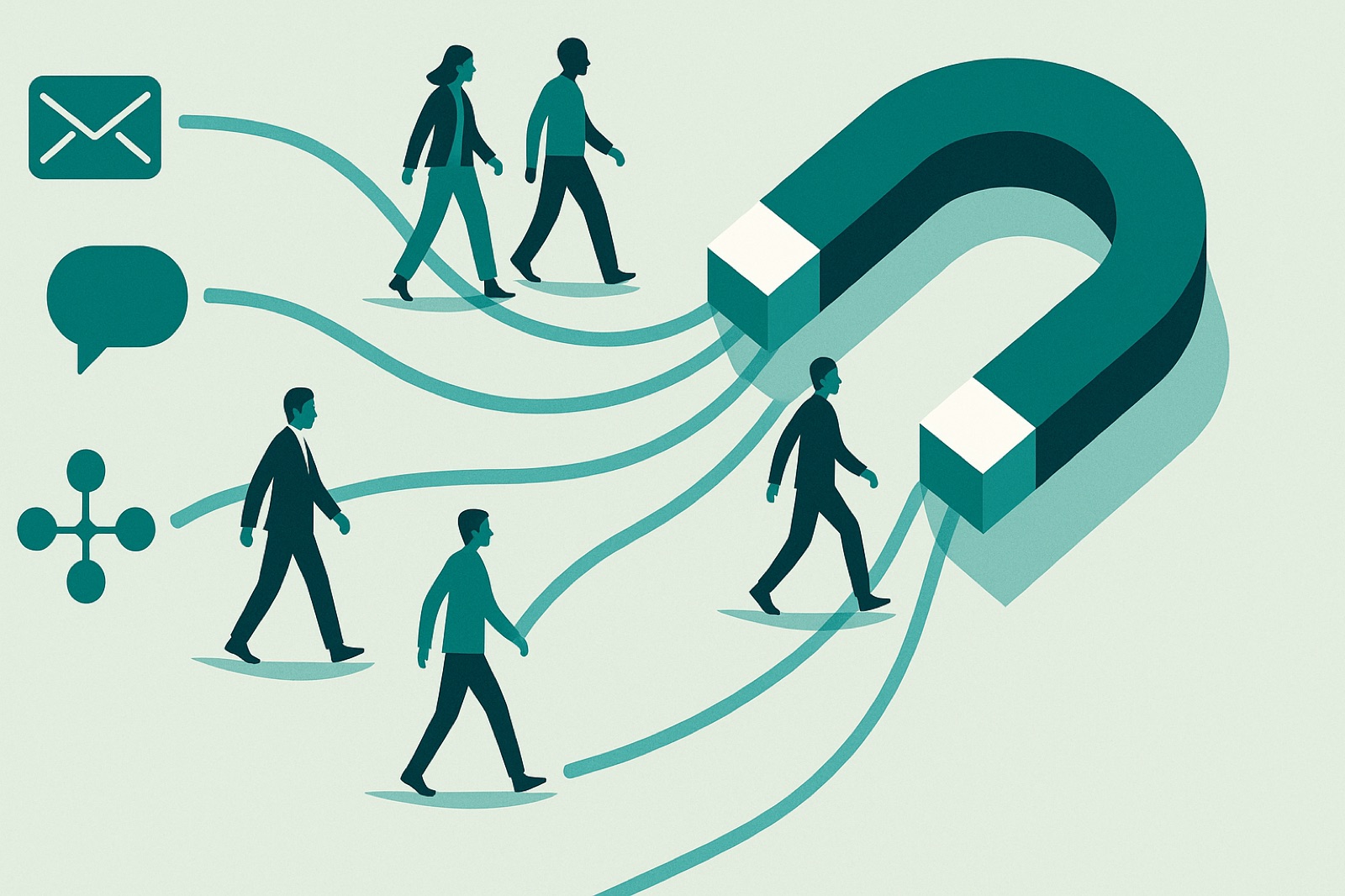
You generate B2B leads for free with outreach: starting one-to-one conversations with the exact businesses you want as clients, on the channels where they already spend time. Four free channels: cold email, LinkedIn, Instagram, Facebook groups. Same move on all of them. Start a real conversation. Do not pitch. Build a little trust, then ask for the meeting. Email is the best place to start because business owners check it every day. It costs nothing but your time and a bit of nerve. This is the full playbook from our chat with Wandile Shabangu, pulled into steps you can run yourself. From V8 Media. We have run R2+ billion in client sales since 2018.
The full episode of our podcast sits above. We sat down with Wandile Shabangu to unpack B2B outreach, a skill most South African business owners have never properly used.
Below the video: the exact moves from the episode, laid out so you can copy them this week.
What does "outreach" actually mean?
Outreach is simple. You start a conversation with a business you want as a client. The goal is to book a meeting. The goal is not to pitch.
Read that again. Most people get it backwards.
They lead with the sale. They blast a pitch at a stranger and wonder why nobody replies.
Wandile's framing on the show was sharp. You want to start the conversation that is already running inside the business owner's head.
That means you speak to a problem they already feel. You are not interrupting with your offer. You are joining a conversation they are already having with themselves.
Do that, and you stop being a salesperson and start being someone worth replying to.
Who should run a free outreach campaign?
If you own a business, this is for you.
Anyone can do it. But you need to know who you are going after, and what problem you solve for them.
Outreach can work business to consumer. But to make a real dent, aim at other businesses, not individuals.
That is the whole point of B2B. One signed client can be worth R20,000 a month, not a R350 once-off. The maths rewards going after companies.
So before you send a single message, get clear on one thing. Who is your dream client, and what painful problem do you take off their plate?
Where to start: go where your market hangs out
The first move is figuring out where your market spends its time.
If your buyers live on Facebook, put your energy there. If they live on LinkedIn, go there.
But if you are not sure, start with email. Business people check their inbox every single day. It is the one channel almost everyone reads.
Here is how the four free channels stack up, so you can pick your first one.
| Channel | Best for | The core move |
|---|---|---|
| Cold email | Reaching decision-makers directly, daily. | Short, personal note. Spark curiosity, get a reply, then pitch. |
| B2B relationships and decision-makers. | Connect, comment for days, then a warm DM. Slow build. | |
| Niche communities and visual brands. | Find where your niche gathers, engage, then DM. | |
| Facebook groups | Tight industry communities (dentists, plumbers, salons). | Add value in the group, then reach out to members. |
You do not need all four at once. Pick one. Get good. Then add another.
LinkedIn carries a lot of weight here. According to LinkedIn's own Marketing Solutions data, around 80% of B2B leads that come from social media come through LinkedIn. So if you sell to other businesses, it earns a spot on your list fast.
Free cold email outreach, step by step
Email is where Wandile said to start. Here is the exact setup so you do not torch your real inbox on day one.
1. Start with burner accounts
A burner account is a throwaway email alias. Not your main business address.
Why? Because beginners blast their whole list with zero practice. People hit "report spam," and suddenly your emails never land.
Once your primary domain gets flagged as spam, getting it back is a nightmare. Future clients stop seeing you.
A burner protects you. If one gets flagged, you bin it and spin up a new one. You keep testing until you find a message that pulls replies.
2. Warm up your emails first
Fresh email accounts that suddenly fire off 200 emails look like robots. Inbox providers bin them.
The fix is the "receive, send, repeat" routine. Sign up for a few newsletters so your account receives normal daily mail. That tells the provider you are a real human, not a spam cannon.
Send emails between your own burner accounts too. It builds a track record of normal back-and-forth before you ever email a stranger.
Gmail and Yahoo now filter hard. Google's own recommended target is a spam-complaint rate below 0.10%. Get flagged and your mail never lands. Warming up keeps you clean.
3. Write a subject line that sparks curiosity
Your subject line has one job. Get the email opened.
Wandile's go-to was simple. "Question about [their business]."
It works because it is personal. It is about them, not you. A business owner cannot help but wonder what the question is.
4. Keep the first email to one or two lines
Do your homework on their niche. Then write almost nothing.
The first email is one or two lines, built to get a reply. Not a pitch. Not your life story.
Do not be arrogant. Do not talk about yourself. Speak to their world.
Skip your fancy email signature. Set it to "Sent from iPhone" instead. It makes the email feel like a real person tapped it out, not a marketing machine.
Only once they reply do you pitch, in email two. Earn the reply first. Always.
Short and personal is not just Wandile's style, it is what the data backs. Hunter.io's analysis of millions of cold emails points the same way: the shortest emails, just a few sentences, pull the best reply rates. Long emails get skimmed and skipped.


How to find email addresses (free and paid)
A campaign is only as good as the list behind it. Here are both routes Wandile shared.
The free way: Google. Manually hunt down the websites of businesses you want to work with, and grab their email off the site.
Businesses set up properly on Google Maps are gold. If they took the time to build out their Maps listing, they care about their business. Those are the ones worth pitching.
The paid way: use a scraping tool like D7 Lead Finder, or hire someone on Fiverr or Freelancer.com to build the list for you.
On the episode, Wandile rated D7 Lead Finder for pulling big batches of addresses cheaply. Pricing has climbed since then, so check the current rate on d7leadfinder.com before you commit. The point still stands: scraped lists are cheap.
But a warning from our side. A tightly targeted list of 300 to 500 of the right people beats a bought list of thousands, every time. Fewer spam complaints, far more replies. Relevance is the whole edge.
Quick legal note for South Africa. POPIA, the Protection of Personal Information Act, governs marketing to people's personal details. The safe path is to identify yourself clearly, target tightly so there is a genuine business reason to make contact, and give an easy way to opt out. This is general info, not legal advice.
The LinkedIn relationship play
LinkedIn is not about blasting messages. It is about building a relationship before you ever pitch.
Wandile's sequence is patient on purpose. Here it is, day by day.
| Step | What you do | Why it works |
|---|---|---|
| Connect | Send a connection request with no message attached. | A blank request feels less salesy. Most people just accept. |
| Comment for 5 days | Comment on their posts. Add real thoughts. Ask a question that invites a reply. | You get on their radar without selling. Target people who post often. |
| The first DM | Once they engage or view your profile, message them. Lead with a compliment on their content. | You are now a familiar face, not a stranger. |
| Ask their advice | Ask for their opinion on something in their field. | Asking advice strokes the ego and puts them on a pedestal. People love being the expert. |
| Thank them | Thank them for the chat. Note how rare a genuine conversation is on LinkedIn. | Builds goodwill. You are different from the pitch-slingers. |
| Raise the problem | Wait 2 or 3 days. Bring up a problem you have spotted in their business. Ask permission to show a short Loom video or testimonials. | Permission-based. You are solving, not selling. |
| Ask for the meeting | Invite them to a quick call. | By now you have earned the right to ask. |
Here is the bonus. Even if they have no use for your service, you have built a relationship. People who like you send referrals.
Why bother with all this patience? Because it converts. LinkedIn's own benchmarks put InMail response rates around 10% to 25%, well above typical cold email. Relationships beat blasts.
Want the deeper LinkedIn play? We unpacked the paid side too, in everything you need to know about LinkedIn marketing with Anthea Chittenden.
Instagram for B2B leads
Instagram sounds like a B2C channel. But Wandile showed how to mine it for B2B.
Start with a business profile. Then find where your niche gathers. Often that is a meme page or a community account.
Here is the clever bit. If a niche meme page has 500 followers, that is 500 potential prospects sitting in one place.
Follow the people who are active in the recent posts. Then send a direct message.
Open with where you found them. "Saw you on [that meme page]." Then chat about the content. No pitch yet.
Once they follow back, you can see who watches your stories and likes your posts. Those are warm signals.
Reach out to the consistent story-viewers and ask if they would be interested in what you offer. That is where you can pitch and keep the conversation going.
Facebook groups for B2B leads
Facebook groups are an underrated goldmine for niche industries.
Decide first: use your personal page, or build a fresh account for your target audience. Either works.
Then search for groups where your buyers gather. Targeting dentists? Type "dentists" into the group search. You will find plenty.
Join, and you get the member list. That is your prospect pool.
Now add value. Share genuinely useful content in the group to spark conversation. Do not spam your offer.
From there you have options:
- Approach members directly with the same two-step method you use on email.
- Message business pages directly. Just pace yourself. Facebook throttles how fast you can send, so go slow to avoid restrictions.
- Reach out to the group admin and ask to host a webinar for the group. Pure positioning gold.
Add real value in the group and people come to you. No pitch required.
Optimise your profile before any of this
One rule cuts across all four channels. Optimise your profile.
The moment you start a conversation, people click your name. They check you out.
If your profile is empty or confusing, the conversation dies right there.
So make it crystal clear. Who you are. What you do. One glance should tell a prospect you are worth talking to.
Cheapest win in the game. Fix it once, and every conversation you start after that lands better.
Free outreach vs paid ads: which should you use?
Free outreach is brilliant when you have more time than money. It costs nothing but effort.
But it does not scale endlessly. There are only so many DMs you can send in a day.
Paid ads flip that. They cost money, but they scale fast and run while you sleep.
| Free outreach | Paid ads | |
|---|---|---|
| Cost | Your time only. | Ad spend, from a few hundred Rand a day. |
| Speed | Slow build. Conversations stack up over weeks. | Leads can come within days. |
| Scale | Capped by your hours. | Scales with budget. |
| Best for | Early-stage, tight budget, B2B services. | Growth stage, proven offer, faster pipeline. |
Start free. Prove your message pulls replies. Then pour paid budget on something that already works.
For lead-driven businesses, paid usually means Meta ads and Google ads. Those reach buyers at scale that no amount of manual DMing can match.
One more thing the free route teaches you the hard way. Most people lose leads not on the channel, but on the follow-up. We break that trap down in the biggest lead generation mistakes costing you thousands.
And if you would rather a team built and ran the whole pipeline for you, that is exactly what our AI lead generation system does: the targeting, the outreach, and the follow-up that turns replies into booked meetings.
This episode also pairs perfectly with our deep dive on cold email prospecting with Dave Lichtenstein, if you want to go further on the email channel.
Frequently asked questions
What is B2B outreach?
B2B outreach is simple. You reach out first to a business you want as a client, start a genuine one-to-one conversation, and aim to book a meeting rather than pitch straight away. As Wandile Shabangu put it on the episode, you want to tap into the conversation already running inside the business owner's head by speaking to a problem they already feel. It is outbound, meaning you contact people who have not heard of you. It works best business to business, because one signed client can be worth far more than a single consumer sale, so the maths rewards going after companies.
How do I generate B2B leads for free?
You generate B2B leads for free through outreach on the channels where your buyers already spend time: cold email, LinkedIn, Instagram and Facebook groups. The core move is the same everywhere. Start a genuine conversation, do not pitch, build a little trust, then ask for a meeting. Email is the best starting point because business owners check it daily. The only cost is your time and consistency. The biggest mistake is leading with a pitch instead of a conversation, which gets ignored or reported as spam.
Which free channel is best for B2B leads?
Start with email, because business people check their inbox every day and it is the one channel nearly everyone reads. LinkedIn is the strongest social channel for B2B, with widely cited data showing around 80% of B2B leads that come from social media flow through LinkedIn. Instagram and Facebook groups work well for niche communities, like targeting dentists in a Facebook group or a specific niche on Instagram. The right answer depends on where your market hangs out, so pick the one channel your buyers actually use, master it, then add another.
What tools can I use to find email addresses?
The free way is Google: manually find the websites of businesses you want to work with and pull their email from the site, paying special attention to businesses with a properly set up Google Maps listing. The paid way uses a scraping tool like D7 Lead Finder, or you can hire someone on Fiverr or Freelancer.com to build the list for you. Wandile rated D7 Lead Finder for pulling big batches of addresses cheaply, though its pricing has climbed since the episode, so check d7leadfinder.com for the current rate. That said, a tightly targeted list of 300 to 500 of the right people beats a bought list of thousands, because it brings fewer spam complaints and far more replies.
How do I do LinkedIn outreach without being salesy?
Send a connection request with no message attached, then comment genuinely on the person's posts for about five days to get on their radar. Once they engage or view your profile, send a direct message that opens with a compliment on their content and asks for their advice on something in their field, which puts them in the expert seat. Thank them for the chat, wait two or three days, then raise a problem you have spotted in their business and ask permission to show a short Loom video or testimonials. Only then do you ask for a meeting. Even if they are not a fit, the relationship often turns into referrals.
Is free outreach better than paid ads for B2B?
They do different jobs. Free outreach is ideal when you have more time than money, since it only costs your effort, but it is capped by how many messages you can send in a day. Paid ads cost money but scale fast and run around the clock, often producing leads within days. The smart sequence is to start with free outreach to prove your offer pulls replies, then add paid channels like Meta ads and Google ads to scale the pipeline once you know your message works. Most businesses eventually run both together.
Key takeaways
- Outreach means starting a conversation, not pitching. Tap into the problem already on the business owner's mind.
- Aim at other businesses, not consumers. One B2B client is worth far more than a single sale.
- Go where your market hangs out. If unsure, start with email, because owners check it daily.
- Use burner email accounts and warm them up first, so a spam flag never kills your real domain.
- First email: one or two lines, built for a reply. Pitch only in email two, after they respond.
- Find emails free via Google and Google Maps, or paid via a scraper like D7 Lead Finder (check current pricing).
- LinkedIn is a slow relationship build: connect, comment for 5 days, compliment, ask advice, then ask for the meeting.
- Mine Instagram niche pages and Facebook groups for prospects. Add value first, pitch later.
- Optimise your profile before anything else. Every conversation sends people to check you out.
- Start free to prove your offer, then scale with paid Meta and Google ads.